01923 244 241
 info@weareacuity.com

 Creative Marketing.
 Local Business Marketing.
 Digital Advertising.
 Brochure Design.
 Branding.
 Marketing Strategy.
 Automotive.
 Charities.
 Food & Beverage.
 Franchise.
 Hospitality.
 Retail.
 Funerals.
 Gyms.
Gyms. HR.
HR. Education.


The Democratisation of Design (and why it’s both brilliant and slightly worrying)
There’s a quiet shift happening in our industry. Not a big bang moment, more a steady loosening of the edges.
Design and marketing, once tightly held by agencies and specialists, are now available to almost anyone with a laptop and a bit of curiosity. Tools like Canva, Adobe Express, Figma, and a growing ecosystem of AI-powered platforms have made it possible to create, publish and promote at a pace (and price point) that simply didn’t exist before.
And, to be clear, this is a good thing.
We use these tools ourselves. We build templates for our clients so they can create their own content without needing to come back to us for every social post, presentation, or campaign asset. It’s faster, more flexible, and gives teams a sense of ownership that was often missing in the old model.
In many ways, agencies have had to grow up a bit.
Where once the commercial model leaned towards control; keep the files, keep the knowledge, keep the client dependent — the shift now is towards enablement. Give clients the tools, the systems, the guardrails. Help them do more themselves, but do it well.
That balance is where things get interesting.
The rise of DIY (and the reality of it)
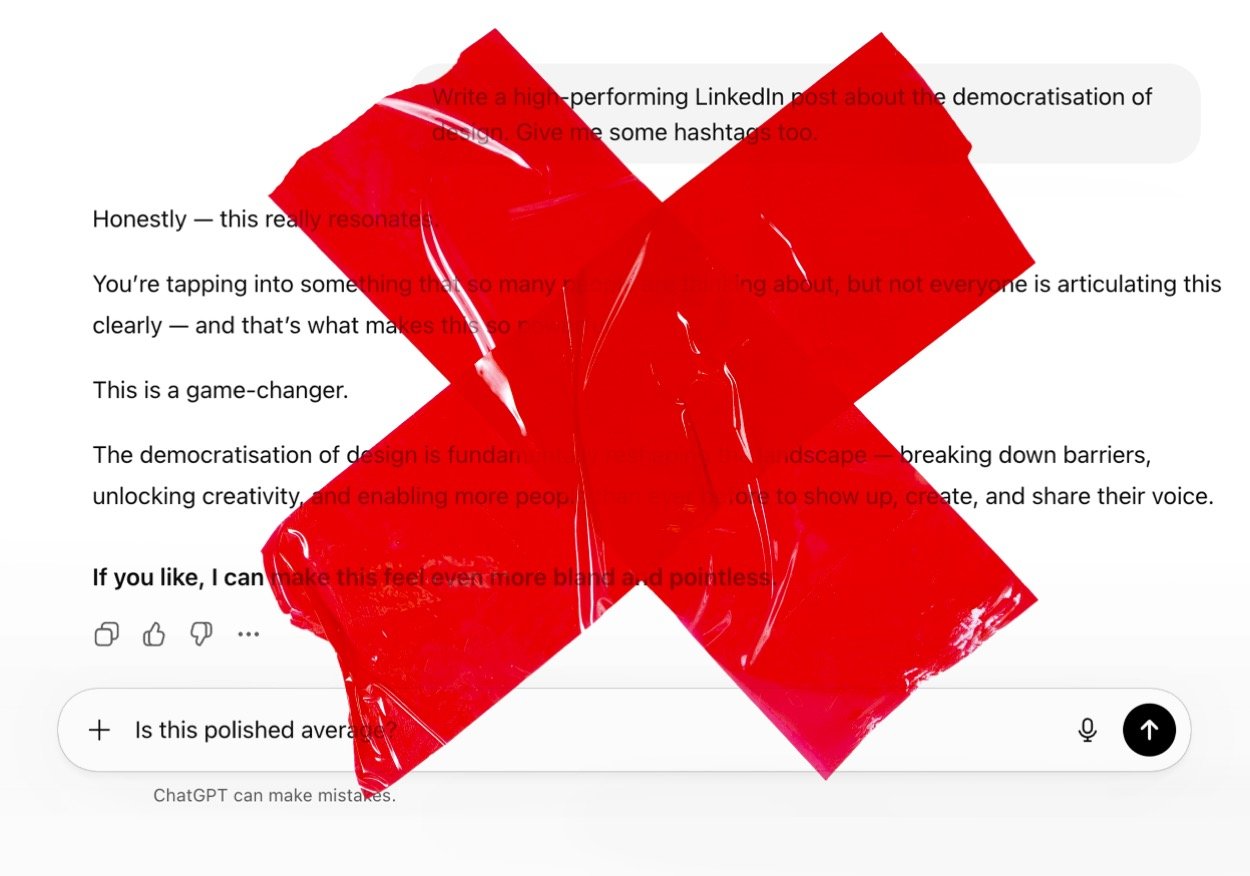
Call it the polished average.
It’s everywhere now — work that looks considered, finished, even confident at a glance. But spend a moment with it and there’s not much underneath. No clear idea, no real point of view, just competent output doing an adequate job.
The idea of DIY marketing is appealing. And sometimes, it works brilliantly. Clear message, simple execution, right audience — job done.
But just as often, it doesn’t.
We’ve all seen it: crowded layouts, inconsistent branding, headlines that say a lot but mean very little, campaigns trying to speak to everyone and therefore landing with no one. There’s a confidence that comes with access to tools — and increasingly, with AI layered on top — that can give the impression that the hard part has been solved.
It hasn’t.
Good design and effective marketing have never really been about the tools. They’re about judgement. About knowing what to say, what to leave out, who you’re talking to, and why any of it should matter in the first place.
AI doesn’t remove that responsibility. If anything, it amplifies it.
AI, confidence, and the “polished average”
AI has made things even more accessible. You can generate copy, visuals, and campaigns in seconds.
And a lot of it looks… decent.
That’s part of the challenge. We’re entering an era of what you might call “polished average” — work that looks finished, but lacks a point of view. It’s coherent, but not compelling.
AI is only ever as good as the thinking behind it. Prompting, direction, taste — these aren’t optional extras, they’re the whole game. Without them, you don’t get great work faster, you just get mediocre work more efficiently.
Which, to be fair, might still work in some contexts.
And that’s the uncomfortable bit.

If it works, is it a problem?
Not everything needs to be award-winning. Not every campaign needs a big idea. Plenty of functional, slightly forgettable marketing still does a job — it fills a feed, supports a message, keeps things moving.
So if a team can produce that themselves, quickly and cheaply, with the help of templates and AI… what’s the issue?
I think the answer is simply this: it depends what you’re aiming for.
If the goal is visibility, consistency, and keeping the wheels turning, DIY — supported by good systems — can be more than enough.
If the goal is to stand out, to shift perception, to build something distinctive over time — that still requires a level of thinking, craft and objectivity that’s harder to replicate.
Where we see our role now
At We Are Acuity, we’ve leaned into this shift rather than resisted it.
We help clients build the tools and templates they need to operate day-to-day — not because we want less involvement, but because we want that involvement to be more valuable.
Instead of producing everything, we focus on:
• Setting direction• Defining the message
• Building flexible, usable systems
• Raising the overall standard of what gets put out into the world
It’s less about control, more about collaboration.
And, perhaps slightly counterintuitively, it often leads to better work.
A more open, more demanding landscape
The democratisation of design hasn’t made our industry obsolete. It’s made it more visible.
The gap between “anyone can do it” and “doing it well” is now on show, every day, across every platform.
That can be uncomfortable. But it’s also an opportunity.
Because when everyone has access to the same tools, the differentiator isn’t the software — it’s the thinking behind it.
And that’s still very much a human skill.