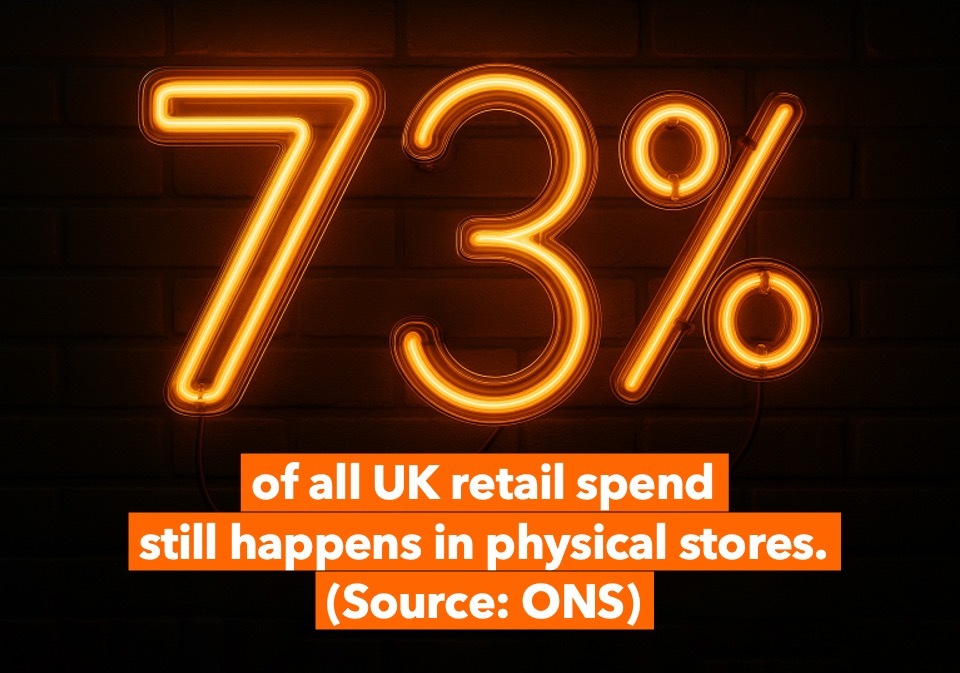
Around three quarters of all UK retail spend still happens in store. Online has grown significantly over the last decade, of course, but the balance has now stabilised with the majority of spend still flowing through physical tills, not virtual baskets.
Yet if you read the headlines, you would think every high street from Penzance to Perth is boarded up and abandoned. The story that sells newspapers and attracts clicks is the one about closures, decline and “the end of shops as we know them”.
The reality on the ground is very different.
On the face of it, it’s useful. People search for local agencies. Local brochure design. Local marketing support. Local people who understand their business and won’t require three trains, a packed lunch and a hotel booking to have a sensible conversation.
Walk any busy high street, retail park or shopping centre and you can see it. Retail is adapting, reshaping and reinvesting. The mix of brands and formats is changing, certainly, but the core truth remains, people still like to visit shops.
Chains like Hotel Chocolat, Waterstones, Greggs, MANGO, SEPHORA, Primark, Superdrug, GAIL’s, Loungers, IKEA, Screwfix, Waitrose, John Lewis, Rituals, Oliver Bonas, Costa, Co op, Dunelm, Specsavers, Søstrene Grene, Newcastle Building Society, Holland & Barrett, Edinburgh Woollen Mill and many more are actively investing in, and in many cases expanding, their store estates.
These are not sentimental decisions. They are made on the back of hard data and rigorous commercial analysis.
Of course, any good retailer will continuously review their estate, closing or relocating stores that no longer make sense and opening in new catchments that do. That is simply good practice. But that is a very different story to “the death of physical retail”.
If physical retail was truly in terminal decline, this level of investment simply would not be happening.
Free Webinar: #5 #5 How to Improve Your Brand's Local Marketing.

Then there are the brands and businesses we hardly ever see in the headlines.
Alongside the big names, hundreds of thousands of independent retailers are opening, moving, refurbishing and quietly thriving. Cafés, barbers, salons, delis, bike shops, refill stores, repair specialists, bookshops, galleries, artisan bakeries, local fashion boutiques, you name it.
Add to that the thousands of heritage and long standing shops that have traded on the same high streets for decades. The family butchers, the local chemist, the neighbourhood convenience store, the independent optician, the greengrocer, the hardware store that seems to have absolutely everything somewhere in the back.
These businesses do not issue glossy press releases every time they reinvest. They simply get on with serving their community. As a result, they rarely fit the media narrative, so they are almost invisible in the national conversation about “the high street”.
But to local people they are anything but invisible. They are part of the fabric of everyday life.
So why does the doom narrative persist?
Closures are visible and emotional, especially when a well known brand disappears from a town centre.
Openings are more fragmented, spread across multiple brands and formats, so they do not make one neat headline.
Online growth makes a simple story, “everyone shops online now” is easier to write than a nuanced view of omnichannel behaviour.
National media is not local, it rarely reflects what is happening in a specific town, city or region.
The result is a mismatch. On the one hand, you have a high street that is genuinely evolving, with a mix of chains, independents and service businesses. On the other, you have a national narrative that only surfaces when something closes or a particular policy is under fire.
Ambitious brands are not waiting for the story to change, they are changing how they use physical space.
A few themes stand out.
1. Treating stores as experience, not just inventory
Stores are becoming places to explore, try, taste, test and talk, rather than simply pick things up and go. That makes them more memorable and harder to compete with online.
2. Using physical locations as powerful local media
A well run, well marketed store is more than a place to transact, it is a highly visible, highly trusted local touchpoint. Window displays, local partnerships, events, sampling and community initiatives all help turn “just another shop” into a local presence with real pull.
3. Connecting digital and physical properly
Click and collect, store locator pages, local landing pages, local social content and email that references a shopper’s nearest store all help turn physical locations into an integral part of the customer journey, not an afterthought.
4. Thinking locally, even in national or global brands
The brands that win at scale understand that each store trades in a specific local context. They flex messaging, ranges, promotions and partnerships to reflect that, rather than blasting out the same thing everywhere and hoping it sticks.
If you buy the “death of the high street” story, you risk treating physical retail as a declining asset to be managed down.
If you look at what is actually happening on the ground, a different picture emerges.
Customers still want to visit stores.
Big brands are investing in their estates.
Independents and heritage shops continue to anchor local communities.
Physical locations are becoming richer, more connected and more experiential.
Physical retail is not dead, it is evolving, and for brands willing to invest it remains one of the most powerful ways to build relevance, trust and loyalty at a local level.
The real question for ambitious, multi location brands is not “should we still have stores”, it is:
How do we make every location work harder as a local, human, high impact part of the customer journey?
Let's talk.
FREE DISCOVERY CALL
see how we can maximise your marketing.